> For the complete documentation index, see [llms.txt](https://helps.ptengine.com/llms.txt). Markdown versions of documentation pages are available by appending `.md` to page URLs; this page is available as [Markdown](https://helps.ptengine.com/en/experience/campaign/create-new-2/bandit-algorithm.md).
# Smart Traffic Allocation: Bandit Algorithm
In this section, we will explain what Smart Traffic Allocation is and how to properly configure an Experience deployment using it. Before reading this section, we strongly recommend that you first review the [A/B Testing](/en/experience/campaign/create-new-2.md) documentation.
### What Is the Smart Traffic Allocation Bandit Algorithm
This section focuses on the logic behind Smart Traffic Allocation. Understanding the Bandit algorithm will help you design better Experiences. If you are already familiar with Smart Traffic Allocation, feel free to skip ahead to the configuration instructions.
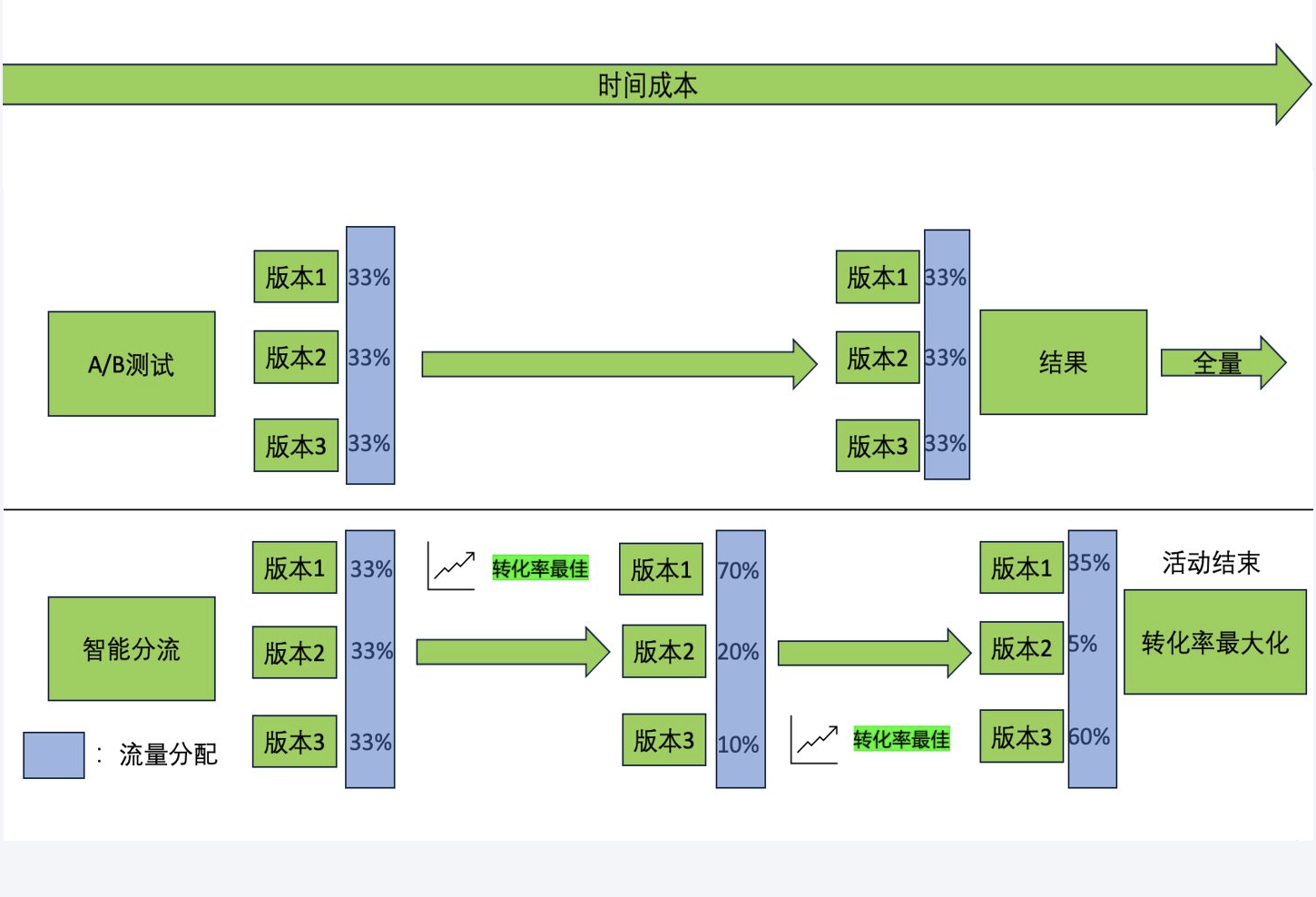
In simple terms, the Bandit algorithm is an intelligent traffic management system that automatically shifts traffic toward the best-performing variation based on a specified conversion goal.
The Smart Traffic Allocation algorithm implemented in Ptengine automatically decides whether to leverage the current best-performing variation or explore other potentially promising ones, gradually reaching a balance between exploration and exploitation. During this process, it saves traffic that would otherwise be wasted on low-performing variations in a random A/B test, eliminates the cost of manually adjusting traffic, and makes traffic allocation more scientific and objective. Additionally, it adapts well when new variations are added mid-experiment -- the algorithm does not fully reset its allocation strategy when a new variation is introduced.
### How to Configure a Smart Traffic Allocation Experience
1. When editing an A/B test or redirect test, go to the traffic allocation settings.
2. Select the Smart Allocation option, then choose a conversion goal.
\
The conversion goal selection works similarly to A/B testing. Ptengine recommends choosing the most intuitive metric you want this creative to influence. (For example, if the creative is a "campaign page traffic popup," select "campaign page redirect" as the goal.) 3. Finally, click Confirm and publish the creative to complete all settings. You will also notice that the traffic allocation displays as "Auto," and the A/B test report interface differs from the traditional one by omitting the "Lift" and "Win Rate" columns.
### How to Properly Understand Smart Traffic Allocation
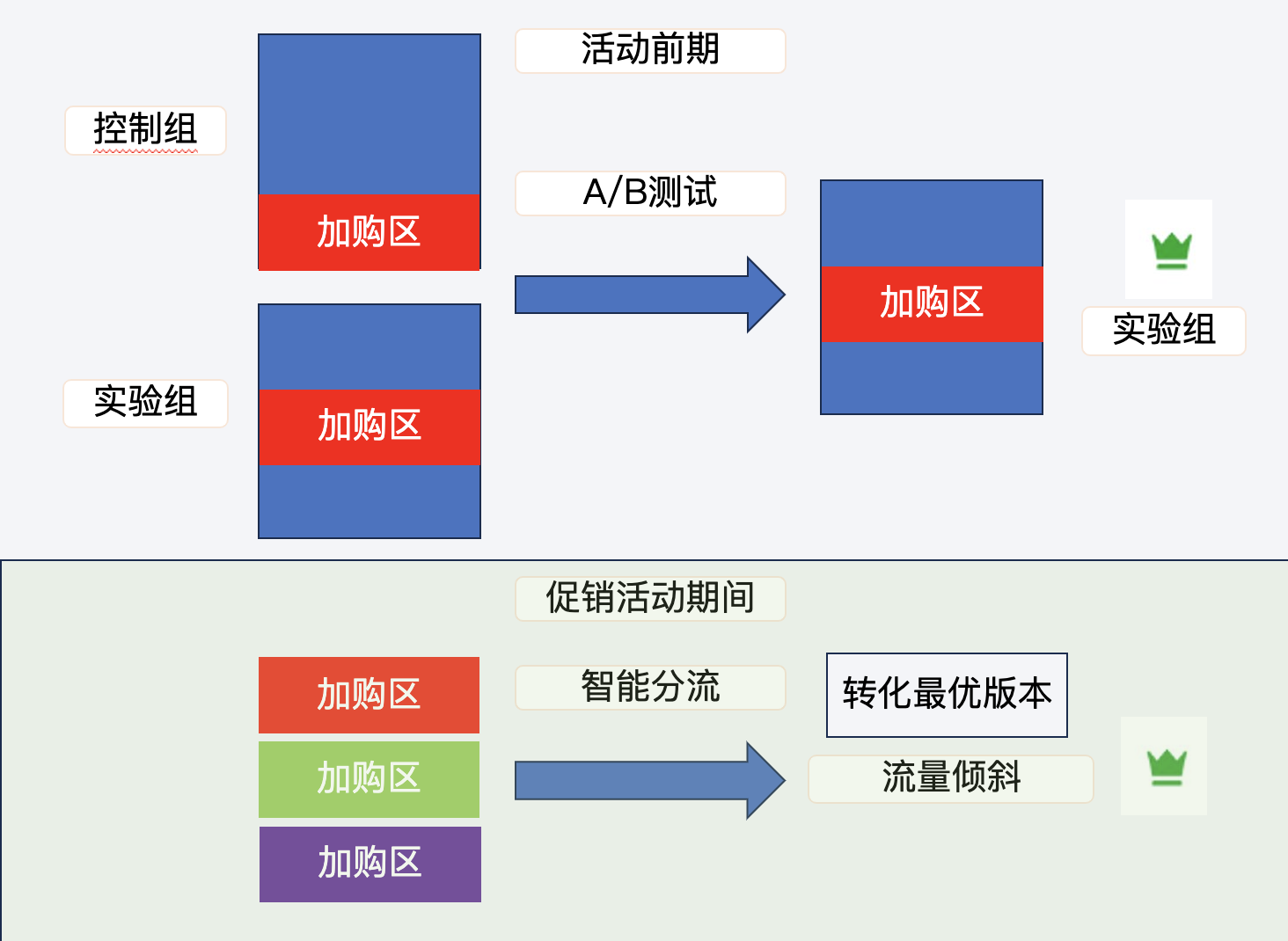
Two diagrams can help you quickly understand the role of Smart Traffic Allocation and the difference between A/B testing and the Bandit algorithm:
❶ Experimental Differences Between A/B Testing and Bandit
❷ Combining A/B Testing with Bandit
Step 1: Use A/B testing to validate a hypothesis (e.g., placing the add-to-cart section at the bottom vs. the middle of the page).
Step 2: During a campaign, create multiple style variations around the validated idea (colors/styles). Step 3: Use the Bandit algorithm to direct traffic toward the best-performing variation in real time.
### **When to Use A/B Testing vs. Smart Traffic Allocation**
When you want to invest time and traffic to validate whether a strategy is effective and plan to apply the results to future decisions, we recommend using A/B testing.
When you want to maximize value from multiple variations within a specific time period (e.g., a one-week or one-month promotion), we highly recommend Smart Traffic Allocation.\
If you have any further questions, please feel free to contact your Customer Success Manager for a quick walkthrough of product features and benefits.